
A year in the water: reflections on our ABL Programme

Every year, a group of young people joins the I AM WATER team as part of our Adventure-Based Learning (ABL) programme, to train as ocean guides, facilitators and conservation educators. By the end of the year, their work will involve leading large groups of children through tidal pools and snorkelling experiences, and teaching them about the sea.
At the start of 2026, several of this year's trainees couldn't swim. “But every chance they got, whenever they were close to the ocean, they were getting in, trying to snorkel, learning how to move with the currents… They were eager to learn and would spend hours in the water just trying,” says I AM WATER programme coordinator, Marlin Van Sensie.
Most of us avoid the things we're not good at, especially in front of other people. So what makes a young person keep getting into the sea before they know how to swim?

Why Adventure-Based Learning (ABL)?
South Africa has thousands of kilometres of coastline, yet only about 15% of South Africans can swim. That's partly a legacy of decades when beaches and pools were reserved for a white minority, and it still shapes who feels at home in the ocean today.
It also shapes who gets to work there. Diving, marine tourism and conservation all need people who are comfortable in the water, and our ocean economy already supports around 676,000 jobs, with the government aiming for a million by 2033. Meanwhile, youth unemployment reached 47.4% in the second quarter of 2026. That's a huge gap between the young people looking for work and a sector that needs them.
Our ABL programme is built to close it. It's a year-long, fully funded NQF Level 4 qualification for young people aged 18 to 35, accredited through CATHSSETA and delivered in partnership with Contour Enviro Group. Over twelve months, trainees go from learning ocean literacy and communications skills to becoming qualified facilitators, tour guides and nature conservation educators.
The programme runs on three pillars that work together:
The classroom: trainees work through the theory of the qualification, building essential entrepreneurial and workplace skills such as numeracy and communications.
The ocean: trainees spend real time in the water, swimming, snorkelling, and building the confidence, safety skills and ocean literacy that our programmes depend on.
The community: trainees represent I AM WATER in public. They give talks at schools, run workshops that teach children about rivers and the ocean, and guide groups through our local tidal pools.
What trainees learn in the classroom, they practise in the water and then teach at schools. We built it this way because while a qualification can open some doors, it's the hours in the water and in front of classrooms that give trainees the real work experience needed to step into the blue economy.

What trainees are working towards
For a young person who can't swim yet, getting into the sea in front of their peers takes real courage. Our trainees do it because they can see what's on the other side.
ABL is an employability opportunity like no other. By the end of the year, trainees graduate with:
An NQF Level 4 Certificate, recognised across the education, conservation and tourism sectors
Cape Town Tourism registration, so they can work as accredited guides
South African Council for Educators (SACE) registration, recognised for educational roles
And because the programme is fully funded, trainees don't have to choose between studying and working. They learn and work at the same time, in the classroom, in the water and in front of school groups.
But for many trainees, the deepest reason is the ocean itself. Once you've felt what it is to be at home in the water, you want to give that feeling to others. Every hour spent learning to snorkel is an hour closer to standing in a tidal pool with a group of children, watching them discover the sea for the first time.

A year of firsts
Here's what makes our ABL qualification unusual: swimming isn't a requirement to join. Neither is presenting experience or facilitation experience. We fully expect trainees to arrive unable to do many of the things they'll be doing by the end of the year. The real question isn't what they can do on day one. It's whether they're willing to try.
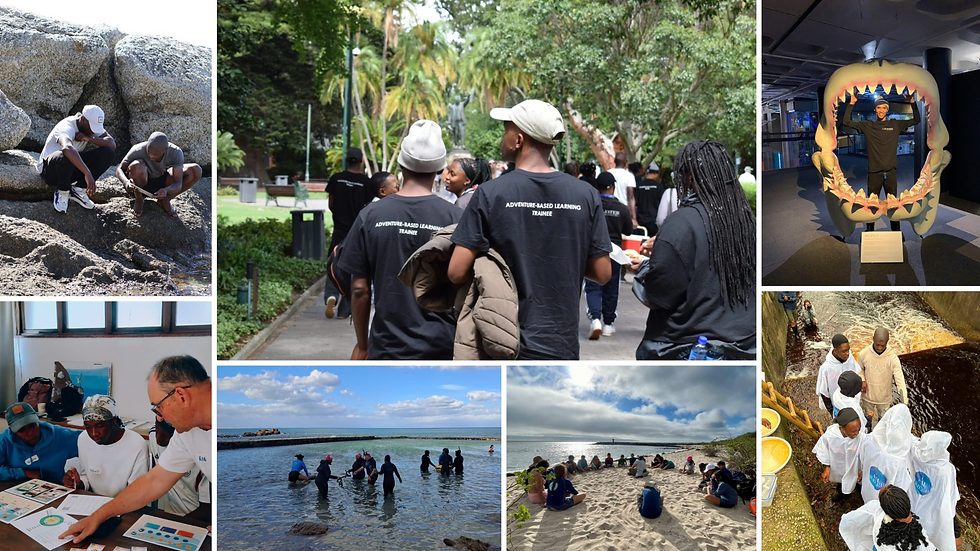
That's why every ABL year is a year of firsts. Some of those firsts we plan for - that's the "adventure" in Adventure-Based Learning. Alongside swimming and snorkelling, trainees might find themselves paddling a dragon boat, finding their balance in a kayak, or standing waist-deep with a surfboard, waiting for their first wave. Other firsts happen on land: a first school talk, a first workshop, a first group of children following them across the rocks of a tidal pool.
Each moment asks the same thing: step into something unfamiliar and see what happens. Every "first" builds a growth mindset, the knowledge that you can feel nervous and do it anyway, and that getting it wrong isn't the end. Over twelve months, the courage to try becomes a habit, one that follows trainees into job interviews and new opportunities long after the year is done.
In 2026, that willingness to try was something this cohort brought with them. Our thirteen trainees came from different cultures and communities, each seeing the world a little differently, but they shared a real curiosity. "I was most impressed by this group's willingness to try everything," says Marlin.
What 2026 taught us
Looking back, these are the lessons from 2026 which the team keeps coming back to:
Connection comes first. We saw this most clearly at our Team Leader camp, where trainees spent three days at the Glencairn Rotary Youth Club hiking, foraging, playing leadership games and completing their facilitation examinations. Away from the classroom, they saw each other a little more openly, communicated more, and connected on a deeper level.
"That kind of connection shows up in the work," says Taahirah Sait, I AM WATER's other programme coordinator. "A team that knows and trusts each other communicates better, shares the load, and steps in when someone is struggling. It makes the whole group more efficient, and more generous with each other along the way."
Asking for help is a skill. Our trainees come to ABL from different backgrounds and educational histories, and each finds different parts of the programme challenging. For one, it's the theory and communications work in the classroom. For another, it's standing up in front of a crowd. For others, it's learning to swim. At some point in the year, every trainee meets their own challenge, and every one of them has to ask for help to get through it. It helps that our coordinators have been through the programme themselves. Both Marlin and Taahirah started out as ABL trainees before becoming programme coordinators, and Marlin also joined I AM WATER unable to swim.
"That's why it matters so much to us to create an environment where asking for help feels easy and normal," says Marlin, “Watching this year's trainees learning in the tidal pool reminded me of when I first started at I AM WATER. It's really challenging when you haven't grown up with a relationship to the ocean - it takes trust and confidence to get comfortable in the water."
Adaptability is part of the job. Behind the scenes, it was a year of change. The team moved into a new office and adopted new ways of working midway through the programme, all while school bookings, workshops and a full cohort kept moving. Asked to sum up 2026 in one word, Marlin chose "crossroads" and Taahirah chose "resilience." "There was so much change," says Marlin, "but we worked together, adapted, and never steered away from our mission."
By the end of 2026, the trainees who started the year unable to swim were spending hours in the water. The group had guided hundreds of schoolchildren through our local tidal pools and spoken to crowds of learners about their love for the ocean. And three of our thirteen trainees have been offered internships, at organisations including Nature Connect and Pieces Divers, before they've even graduated.
For many of them, the year was about more than just a qualification though.

Looking ahead
In December, we'll welcome a new group of trainees into the programme for our 2027 cohort. They'll also come from different places, with different strengths and different things they find hard. Some of them won't be able to swim yet. That's alright. If this year taught us anything, it's that where someone starts matters far less than whether they're willing to try.
To our 2026 ABLers: thank you for trying everything. We can't wait to see where the water takes you next!


Comments